
Introduction: The Channel Strategy Question
Many small consumer products businesses start out selling direct to consumer. Once they establish themselves as a profitable enterprise, the next boost in growth is likely to come from wholesale and other channels. When and why to pivot from DTC to wholesale is critical to know. We will take a deep dive in one of these businesses.
The business is a craft manufacturing and retail operation focused on a relatively small niche with loyal customer base. It has sold direct-to-consumer for the last four years and acquired several retail partners along the way. The shift comes with several tradeoffs as follows:
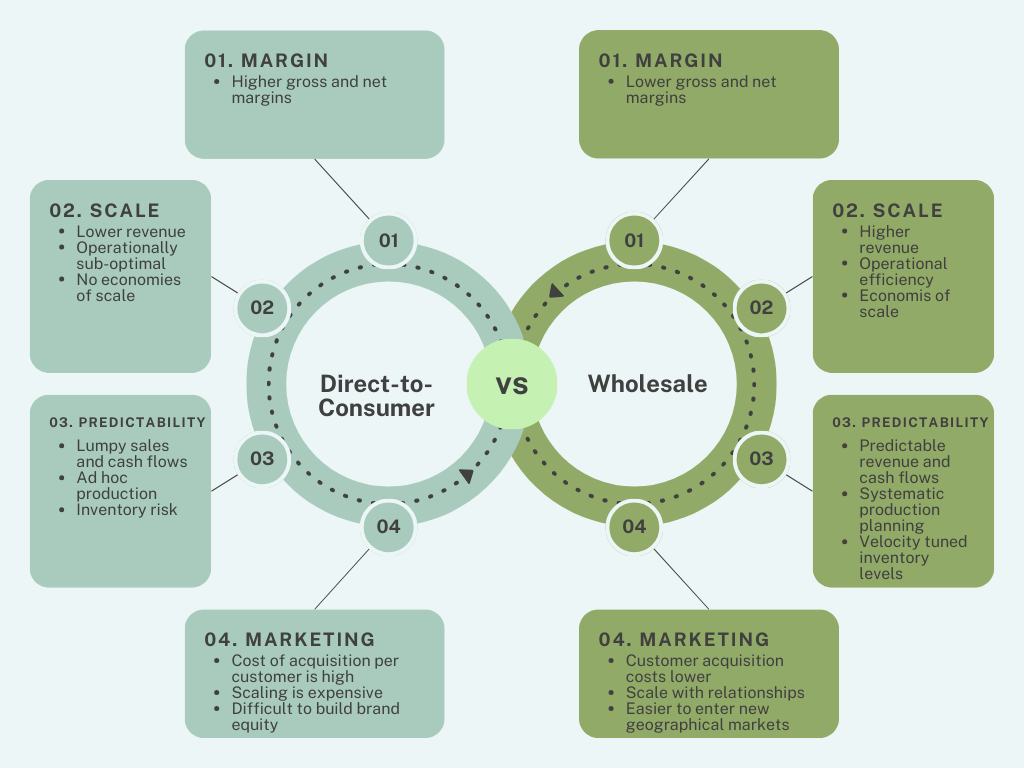
Which is the right model? It all depends on the long term strategic objective. The goal of increasing market share requires scale and that comes with the tradeoff of lower margins. Alternatively, one can maintain high margins and stay as a boutique player. In this case, the long term objective of increasing market share is driving the decision to shift the channel mix towards primarily wholesale.
The DTC Model: Strengths and Constraints
The DTC model works well during the startup phase to gain traction. Higher margins help fund the reinvestments needed to build the basic operational infrastructure and to purchase raw material inventory. It also helps create a catalog of viable products by rapid prototyping and immediate customer feedback. However, as the businesses look to scale, there are clear barriers that need to be overcome.
| Strengths | Constraints |
|---|---|
| Higher gross margins The margin is not shared with any intermediary when selling to the customer direct. | Customer acquisition cost volatility Each customer needs to be acquired individually. The acquisition costs can vary significantly between channels and over time. |
| Brand control The business can control the brand messaging very granularly. It is easier to maintain consistency and all channels are firmly under control of the company. | Marketing dependency Marketing drives customer acquisition and if marketing stops, customer flow stops as well. |
| Direct customer feedback DTC means the customer feedback is direct and immediate. This helps determine the viability of the products, helps establish market prices, and allows the company to refine and update the products based on customer reviews and feedback. | Inventory risk Sales are lumpy and not predictable. Therefore finished goods can sit in inventory longer than expected. This also makes it difficult to plan production and base inventory levels. |
| Data ownership The business owns customer data including email addresses and demographics. This is important for future marketing strategies as well as engendering repeat business. | Operational fragmentation There is no economies of scale. This implies that the operations are not yet streamlined and efficient. |
| Revenue variability At lower sales volume the revenue is unpredictable. | |
| Scaling requires disproportionate marketing spend Scaling is difficult but can be achieved with further marketing spend. Customer retention is low and can be more expensive than wholesale. |
Strategic Drivers Behind the Pivot
The rationale behind the pivot to wholesale model rests on the future vision of the business. In this case, the management determined that they want to scale and acquire further market share and are willing to accept lower margins in the process. It is expected that higher revenues will result in higher net profit, even as the profit margin in percentage terms declines. The pivot is also being drive by the following:
Revenue Stability vs Margin Maximization
One of the characteristics of wholesale model is that the customers tend to repeat their purchases at regular intervals. As a result, once the wholesale pipeline is sufficiently filled, the revenue stabilizes and becomes predictable. Each wholesale account adds 100s of customers per year to the order flow. This allows the company to scale its customer acquisition rapidly.
A stable and predictable order flow at a higher level allows the company to implement a solid production planning and resource management program. The benefits are across the board: economies of scale, better production planning and scheduling, improved inventory management processes, etc.
Capital Efficiency
In the DTC model for a small operation, capital is not used efficiently. Inventory turns slowly tying up capital. Working capital cycles are long which makes external funding hard to obtain and service. Products are manufactured on an ad hoc basis and batch production efficiencies do not yet exist. It is also hard to correlated marketing investments with sales conversions but at the same time DTC model requires more marketing dollars invested for each new customer gained. A pivot to wholesale fixes a number of these problems as volumes increase, stabilize and become more predictable.
Once the business is able to accurately track the sales velocity of each SKU, it can start to optimize the inventory levels and reorder points. This improves the inventory turnover by ensuring that we keep the minimum amount necessary in the inventory while ensuring that we do not run out of stock. This shrinks the working capital cycles. Funding decisions become easier. Higher inventory turnovers also means faster compounding of returns on the initial investment.
Wholesale is primarily a relationship based channel with significant number of customers returning in the future. Each order includes multiple SKUs and multiple units of each SKU in the order. This increases the order size and makes batch production possible.
Operational Focus
Every early stage DTC operator understands the need to continuously market. Each customer is earned one at a time. If the business is online, this will also include continuous content production. When you stop marketing, customers stop coming.
This makes retaining a customer extremely important. A repeat customer is less expensive to acquire. Customer retention can be improved by investing in excellent customer service, as well as other customer facing aspects of the business (website, email marketing, etc.).
DTC businesses make products in small batches and this introduces variability in the product quality as production gets switched in and out.
Adding the wholesale channel alleviates most of these issues. Batch production improves quality and consistency, as well as throughput. SKUs are simplified. There is not need to offer Widget A in 10 different colors if you know that red and blue colors drive 80% of the sales. Driving higher volumes through production planning process improves efficiency by a number of factors.
However, the most critical benefit of selling into wholesale channels is the focused relationship management. Instead of managing 1000s of different retail customers, the business only needs to cultivate and maintain a few important relationships. These relationships drive the volume and they ultimately sell to the retain customers.
Channel Power Dynamics
Consider organizational capabilities and decide on a channel strategy that aligns with these capabilities.
DTC involves significant customer acquisition competition. Ecommerce marketing is saturated with diminishing returns. It does not matter whether you sell through owned platform or on marketplaces. Organic digital marketing (SEO, Social Media, etc) now has long cycles and lack of reliability. Is the company willing to invest in the DTC channel to grow large audience and customer base?
Wholesale channel runs on relationship and a few talented sales/marketing professionals in the company can generate significant growth as each new wholesale customer means 100s and 1000s of new retail consumers are acquired. A small number of relationships drive significant revenue and business scales faster. What we lose in margins, we gain in increased sale. The retailers that purchase through the wholesale channels drive customer growth and market penetration supported by their own marketing dollars.
Execution Plan
The transition from DTC to wholesale channels is structured to be completed in 4 phases. These phases take the business through the internal adaptations necessary to support wholesale partners and prospecting and acquiring retailers to buy from the company in bulk.
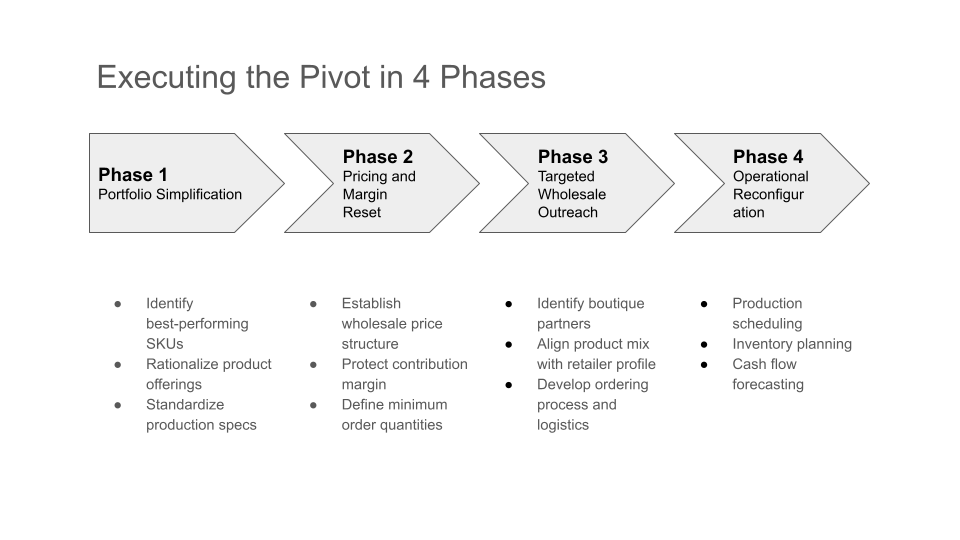
Phase 1: Portfolio Simplification
Selling DTC created a large catalog of products with a number of variations. This included core products, products that are being market tested, customizations requested by customers, etc. A wholesale catalog requires locking in the core SKUs and standardizing all the variations (colors, sizes, etc). This is a necessary exercise to perform atleast once a year. This is critical to perform when setting up a wholesale catalog.
Phase 2: Pricing and Margin Reset
Understand that the wholesale prices will be lower than the retail prices. The difference between the retail price and the landed wholesale cost (wholesale price + shipping cost paid by the customer) is the gross margin for the customer and this number needs to be large enough to attract boutiques to buy our products.
As the company prepares to relinquish part of its margins, it is important to note that increased scale creates efficiencies lowering our production cost. Additional savings come from a significant reduction in per unit marketing costs. Therefore a part of the gross margin lost due to price reduction is compensated by the gains elsewhere in the value chain.
The wholesale vs retail price ratios depend on the industry and market segment. For high end luxury products, the wholesale-retail price differential can be quite low. For commodity businesses, the price differential needs to be large enough to generate a reliable margin for the buyers. For most retail products, a wholesale price of 40%-50% of the retail price is common.
Phase 3: Targeted Wholesale Outreach
This phase is about finding the retailers that will carry our company’s products. The marketing has to support the pivot so that as we make our internal adjustments, we have the buyers ready to purchase our goods. Not every retailer will carry all our products so it is critical to align the product mix with the retailer profile as we conduct our marketing outreach.
Where do we find these boutique partners that will buy from us wholesale? Some of the possible channelr are:
- Trade shows
- Wholesale marketplaces such as Faire
- Manual outreach through email, phone or personal visits
Marketing needs to be supported by an efficient sales and fulfillment process. Organize your logistics to ensure every boutique that becomes a customer gets the products they need in an efficient manner. This could involve arranging shipping through parcel carriers or LTL carriers, assigning sales/support representatives to each buyer, setting up after sales service processes as needed. An ordering process needs to be developed. This can be e-commerce through a wholesale portal, or it could be completely relationship based.
Phase 4: Operational Reconfiguration
Once the orders start to flow, the production process should be efficient to fulfil the orders profitably and efficiently. The following need to be considered:
- Production scheduling: Have a process to schedule production and train employees to use it. This will ensure that the deadlines are met and production is done to the spec with minimal errors.
- Inventory planning: The goal is to have sufficient inventory to be able to fulfil the incoming orders quickly. At the same time, the inventory shouold not be larger than absolutely necessary. This way, we do not tie up capital in inventory that does not move.
- Cash flow forecasting: The cash flow decides whether we are able to afford the next production run. We need to purchase raw materials and consumbale inventory. We also need to make the payroll and pay the rent for the facilities. If we grow too fast, we may end up using cash faster than we generate it. Consider matching payment term with the cash conversion cycles. At certain time we may want to extend payment terms to our buyers as well. This will require a cash buffer on the books.
Even though we have shown the Phase 4 as occuring after Phase 3, in practice there is considerable overlap.
Early Outcomes and Indicators
The business in this case study is currently in the process of completing this pivot. The wholesale catalog has been mapped and the prices defined. New wholesale partners are being signed up. All this is supported by implementing a function rich ERP system that can keep the catalogs, manage customer relationships, and help with production planning. Early results are excellent. The number of SKUs has be reduced by about 80% in the wholesale catalog by eliminating extra variations and non-core SKUs so the focus is now on 20% of the products that generate 80% of the revenues.
As we move through the various phases of the execution plan, the following indicators are of interest:
- Order size stability
- Reduced marketing spend
- Improved production batching and costing
- Revenue and Margin predictability
- Working capital improvement
Over time we will also measure the market share penetration and brand awareness in the target markets.
Strategic Lessons
Far too many businesses do not pivot to wholesale as they fear a decline in profitability. While this is true, the pivot can unlock higher revenues and ultimately higher profits as measured in dollars. Growth also bring other opportunities.
Discipline is important and knowing your costs accurately is critical. If you do not, you may not know you are losing money until it is too late.
As the wholesale channel grows, it will even out the revenues and make them more predictable. Long term planning is now possible to do with confidence. This can unlock new financing possibilities and also make the business more resilient to economic vagaries.
Execution discipline determines pivot success. Businesses need to be aware of the implications to other part of their operations so the pivot is intelligently designed to create a long term advantage for the company.